Isambard Kingdom Brunel is an almost legendary figure in British engineering.
Embodying the energy and ambition of the period, he had a huge capacity for
innovation in design, and was at the forefront of the group of engineers who enabled
the industrial revolution.
Born in 1806, his father (prominent French engineer and inventor Sir Marc Brunel) always
intended that he become part of the family business, sending him to France at the age of
14 to study practical mathematics. Upon his return he began work on his father's Thames
Tunnel Project, helping establish the world's first pedestrian tunnel under a river.
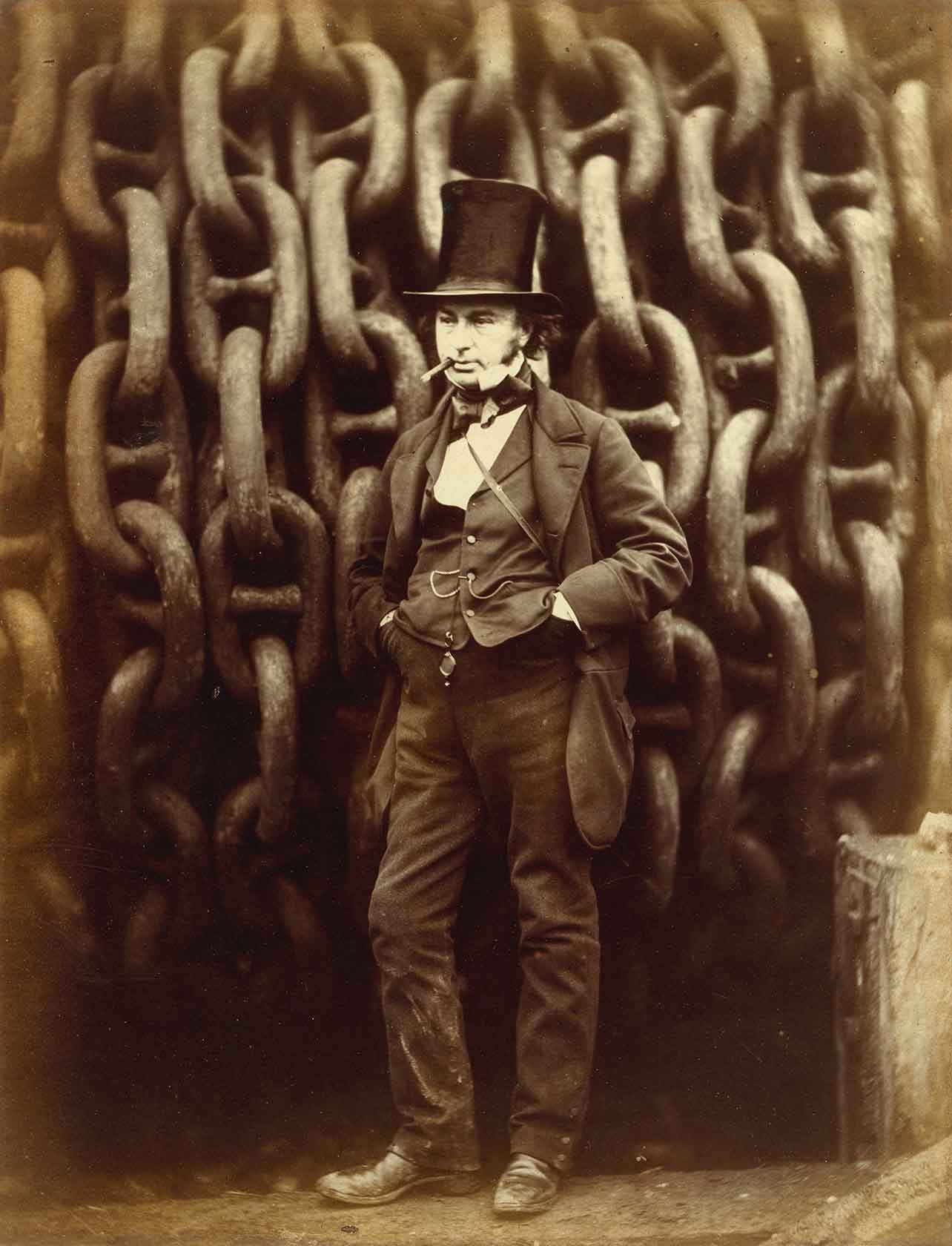
Brunel became famous for his involvement at all stages of the construction process,
(cutting a characteristic figure onsite in muddy trousers and a stovepipe hat in the
latter stages of his career) and was severely injured in 1828 when a flood damaged much
of the tunnel. He went to Bristol to convalesce; but typically didn't remain idle whilst
there, entering and winning a competition to design a bridge across the Avon Gorge. His
pioneering design for the Clifton Suspension bridge was completed after his death.
In 1833 he proposed plans for the rail line from Bristol to London and was appointed
chief engineer to the Great Western Railway. Always good at imagining the practical
realities of design, he wanted passengers to be unaware of the physical struggle of the
train, and to this end incorporated bridges, tunnels, viaducts and embankments into
lines, so that trains could move through the landscape as smoothly as possible, and
passengers enjoy a uniquely luxurious travelling experience.
Paddington Station had to be a flexible space to accommodate the extra influx of people
expected in London for the Great Exhibition in 1851. Brunel sat on a committee
overseeing the construction of Crystal Palace for the exhibition, and used the same
contractors to realize his design for Paddington's elegant arches and spacious roof.
Another successful construction was the Royal Albert rail bridge over the Tamar; an
attractive design crossing the river at its narrowest point. England's railway system
was an immeasurable success. Transforming the possibilities of commerce and trade, it
brought prosperity and modernity to the areas it served; and Brunel achieved great fame
as its chief engineer.
Given how universally Brunel's designs are revered today, it's surprising to learn that
during his own lifetime they were often subject to controversy. He fought for progress
and forward-thinking in engineering, and had a long and only temporarily successful
battle to try and get broad-gauge track used on all railways, to allow greater speed in
train travel. Always seeking new challenges, he turned to shipbuilding, producing ideas
for steamships far ahead of their time. The Great Eastern in particular was an
unprecedented design: far and away the biggest ship ever created at that point, it
featured a screw propeller and a wrought-iron hull. The project was heavily criticized
and suffered major financial difficulties. Under great strain, he endured a major heart
attack in 1859 whilst onsite. He died 10 days later; having been unable to witness the
ship leave on its maiden voyage.